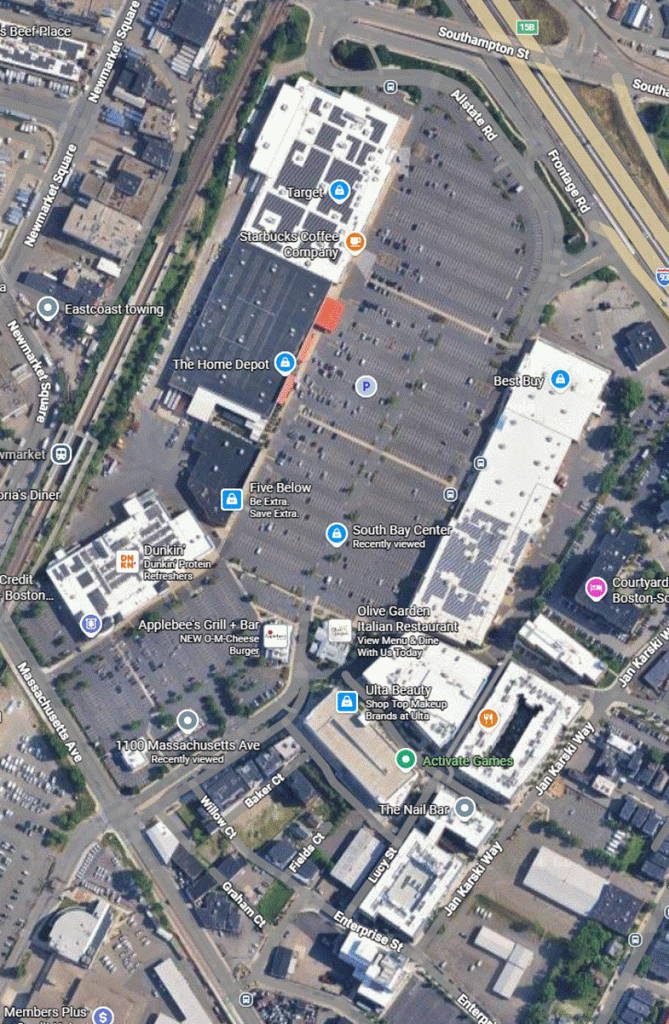
Before we start any type of due diligence or property lease audit, before we get into any documents or financials, we spend time reviewing various resources. My personal “go-to” are aerials, lease/site plans, the GIS and tax data and Google street views for a walk around.
Now that I have put that on paper, I realize that I will likely do a blog post on each of those over the next few weeks. But, today, I will just address the aerial.
So, when you look at this particular aerial, what do you see? I will go through and put some of mine, but, please, add your own insights.
- Three rooftops covered with solar panels
- Who owns the panels?
- Who gets any excess revenue?
- If we (the landlord) own the panels, are we billing back electric to the common areas? At the proper rate?
- Two of the buildings appear to be Stop & Shop and Target – If they own, are they providing their own common area lighting? If so, are we excluding their square footage for the balance of the tenants for common area electricity?
- The different colors of the rooftops
- Often gives a feel for which tenants may be providing their own maintenance.
- If roof repairs are a defined CAM expense for some of the tenants, are we properly excluding their square footage for roof repairs?
- There at Home Depot, we can see the unenclosed garden center. How it that required to be treated for the other tenants for CAM and tax purposes?
- Often gives a feel for which tenants may be providing their own maintenance.
- Numerous freestanding buildings (along with the different color rooftops)
- Again, will impact the building maintenance denominators
- Will likely impact the all-risk insurance denominators (who is responsible for insuring the respective buildings?)
- If any are ground leases that include land for self-sufficient parking, are the ground lease tenants responsible for liability insurance on their premises (land and building) which may impact the liability denominator.
- Stop & Shop’s gas island
- Immediately start thinking about what square footage is being carried on the rent roll and included in the denominators. Some landlords will carry at perhaps the 200 sf building, while others may carry at 2,000 sf under canopy.
- Are we responsible for snow removal under the canopies?
- Olive Garden
- Dead smack in the middle of travel lanes with no parking in those travel lanes
- Start wondering whether that might be a separate parcel. If it is, I am betting it might be footprint only
- Dead smack in the middle of travel lanes with no parking in those travel lanes
- Multi-story buildings with retail on the ground floor
- We start to get excited because we realize that will likely be issues with allocations of expenses among the various uses within the mixed use parcel – retail, office, residential.
- See at least one parking structure
- Start wondering if we charge for parking
- Does the revenue have to get offset against CAM?
- Are the expenses of the structured parking included in CAM?
- Know that there will be complex tax calculations within the center – at least in the multi-use buildings
- Start to think about whether the denominator starts with GLA, or possibly Ground Floor GLA (so above and below ground floor are excluded without even having to state it)
- Adjacent properties with access to our center
- Start thinking about the number of easement and operating agreements that likely exist at the center
- Start thinking about which adjacent parcels (or unowned parcels within the center) should be making contributions.
These are only a few of the insights that you can get by spending time with an aerial. Other things we typically look for:
- Coloration of the asphalt (can tell you which tenants are self-maintaining, or how recently a repaving was done or how soon it may be needed and how critical those restrictions will be in the abstract)
- Detention ponds – Can get a feel for which parcels besides our own might be party to a maintenance agreement.
- Landscaping in the center, and around any detention ponds
- Concentration of parked cars. Are there adjacent, unowned parcels that clearly use our parking?
I am not saying all of these issues exist at this center. But, by analyzing the aerial in advance, we can adjust our plan of attack for an acquisition of property lease audit. Some of these issues may never have been addressed in a center, but they are all issues that can affect the center’s cash flow.
One final thought/insight that can be gained from viewing an aerial. A really good friend, Mike Winters (formerly of Cedar Shopping Centers), had such outstanding experience with his ability to analyze an aerial, that he could use the aerial (in conjunction with a pass through the produce, meat and dairy section of a grocery store to fairly accurately determine a supermarket’s sales per square foot. How is that possible from an aerial? He could look at how far out the oil stains went into the parking field to see how much parking was used regularly. Mike always made me recognize that I was just a novice!
In my next post, I will address some of the issues that can be identified/triggered by viewing the lease and site plans.
 What's new in lease administration?