In commercial leases, especially retail leases, it is common to see that tenants can, or should, be billed based upon the square footage of the property excluding portions of the property that are separately assessed. Sounds pretty simple and straightforward, doesn’t it? But in that one sentence, there can be dozens of variations on the requirement.
I will hit a couple of the big ones –
- The tenant will be billed based upon …
- The tenant may be billed based upon…
- Variations of the will and may.
- …are separately assessed…
- … are separately assessed and are the sole responsibility of another party…
- …. Are separately assessed and billed to another party …
These tiny little nuances may seem like nothing. But that can make a material difference in what a landlord bills, and can greatly affect the landlord’s absorption or leakage.
But in a few states, there is an often overlooked factor outside of the leases. In the majority of states, when we have just one tax parcel, all of the buildings on that parcel are valued as one economic unit. However, in a few areas, there is a component assessment performed and provided by the various municipalities.
The natural inclination is one parcel, one assessment. However, when you do a bit of digging, you will find that the assessors have assigned an assessment to each individual building or set of buildings within one parcel, and the values and the related taxes on a per square foot basis. When coupled with the dozens of variations of tax requirements in that simple little starting sentence, it can, and does, affect how much the landlord has to absorb of those taxes.
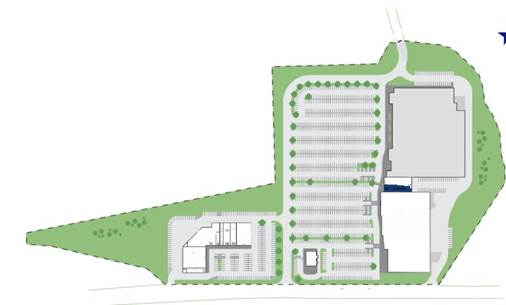
Here’s a real example below of one shadow anchored center. First, the lease plan:
Second, the tax map:
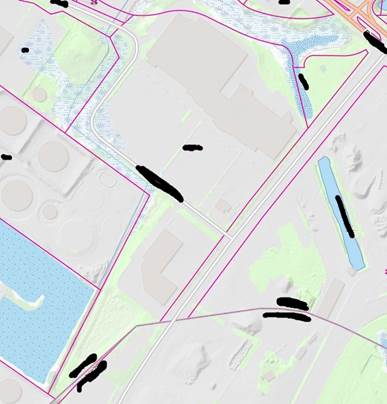
Looking at that, it appears we have one tax parcel. However, the separately owned, shadow-anchor discount store is directly billed. To give you some perspective, the discount store is taxes for the current year at $2.28/sf.
Then, we have another single parcel. It has the L shaped building in the southern portion of the center, a fast food building in the center, and, at the top, a supermarket with some additional inline space. If we look at that parcel as a whole – taxes are just under $4.00/sf – $3.98/sf to be exact.
However, that single parcel is assessed as four separate components. You actually do not see that on that tax bill. It is just one number. But, taking the time to go into the assessment cards, we find different values per building, combining into the total assessment for the parcel. Here is an example of one of the four cards (this is for the fast food premises).
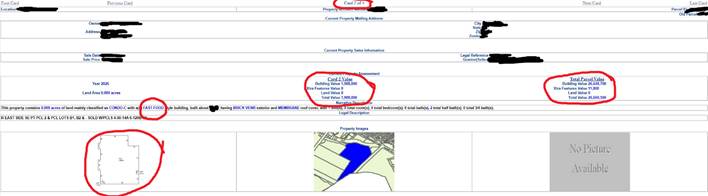
Applying the assessments for this particular parcel, taxes range from a low of $3.30/sf (supermarket) to $4.46/sf (L building) to $5.30/sf (GLA next to the supermarket) to $11.99/sf (fast food).
I don’t know how the tenants are currently being billed, but my guess is that the majority are being billed at this $3.98/sf average, with the possible exception of the supermarket. National and regional big boxes are fairly sophisticated, and know about these separate assessments. So, they would be paying $248k per year vs the $299k per year they’d be paying at $3.98/sf. The landlord may be absorbing $51k per year!!!! Apply an 8-10% cap rate (conservatively), and you are talking $510k to $639k in diminished value!!!!
However, understanding component assessments, a landlord would be able to pick this $51k back up from the other tenants. Even if the supermarket is not being billed at the lower rate, depending upon those “may” or “shalls,” there is still the possibility of that $51k per year pick up.
 What's new in lease administration?